



Background:
The Maghreb and the African Sahel are undergoing rapid geostrategic transformations, in which security and political crises intersect with international competition and economic changes. These developments pose growing challenges to regional stability and the future of the region’s relations with regional and international actors. Political and military shifts in the Sahel region, together with the declining French influence and the rise of new international actors, have reshaped power balances and strategic alliances. These shifts have equally paved the way to a reassessment of traditional patterns of security and economic cooperation.
In this regard, the roles of Russia, China, and Turkey have expanded, alongside the continued presence of other international and regional powers. This has turned the Sahel into a region of competition for influence, resources, and strategic corridors. The growing threats posed by terrorism, organized crime, and illegal migration, together with the effects of climate change and economic fragility, have further complicated the challenges facing the countries of the Maghreb and the Sahel.
The new geopolitical regional reality seems to have compelled Maghreb countries to reassess their foreign policies and their security and development approaches. While Morocco seeks to strengthen its engagement with Africa and advance initiatives for cooperation and economic connectivity with Sahel countries, Algeria continues its diplomatic and security efforts in accordance with its national security considerations and regional position. The other Maghreb countries, too, are seeking to adapt to these transformations in line with their national priorities and strategic capacities.
The region’s stakes extend beyond security concerns to include energy projects and trade and logistics connectivity-most notably gas pipeline projects and Atlantic corridors. These developments raise questions about the prospects for economic integration, the limits of regional competition, and the extent to which such initiatives can promote stability and development across the Maghreb and Sahel.
A number of controversial questions arise concerning the nature of the ongoing geostrategic transformations and their impact on regional and international balances of power. These questions include: How capable are the Maghreb countries of adapting to emerging challenges? To what extent can they develop shared approaches to addressing cross-border threats? Do current developments create opportunities to strengthen cooperation and integration, or do they deepen competition and widen differences in strategic choices?
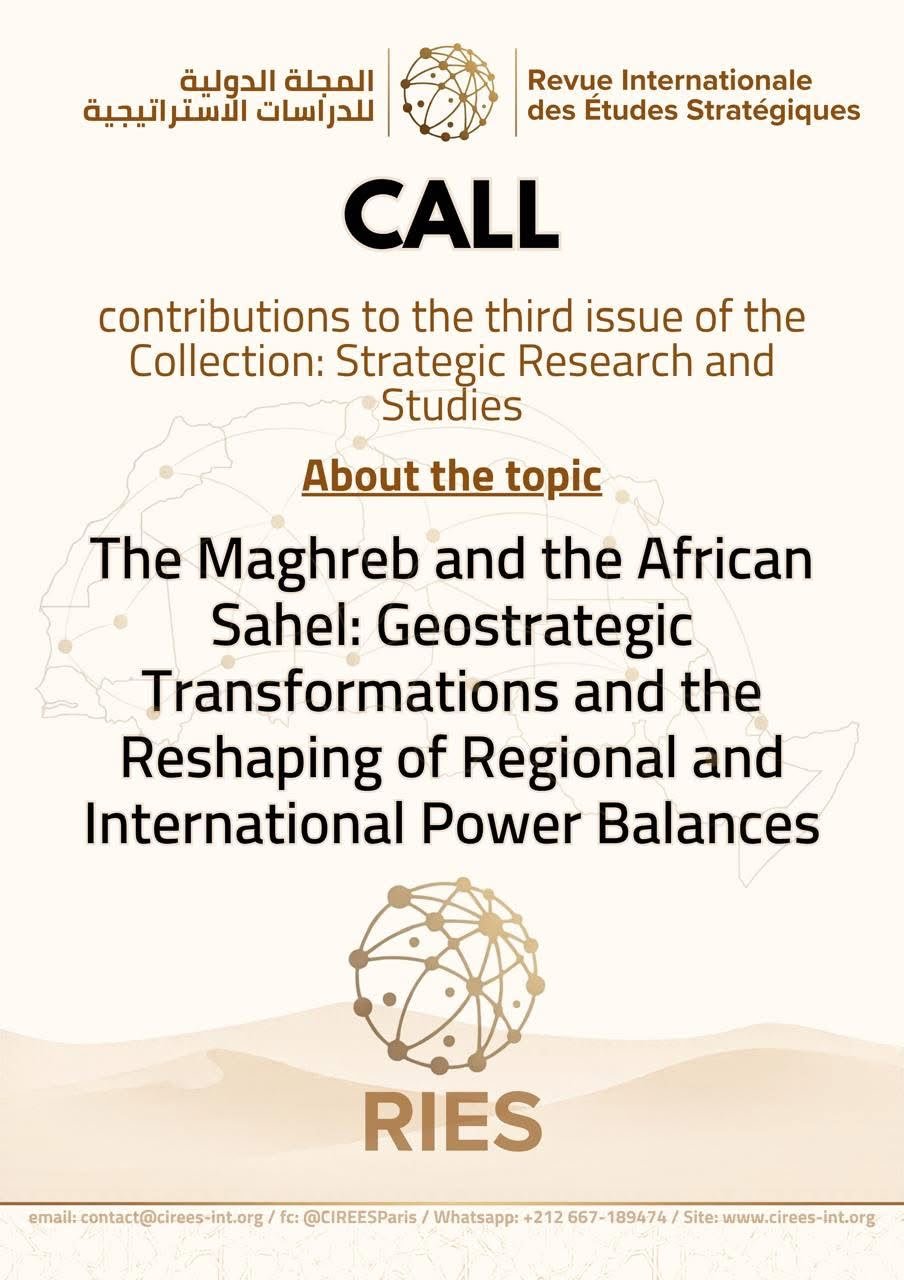
These questions call for in-depth analysis and further scholarly research. This is the aim of the fifth issue of the International Journal for Strategic Studies issued from Paris. The issue is devoted to the theme « The Maghreb and the African Sahel: Geostrategic Transformations and the Reshaping of Regional and International Balances. » Researchers are invited to explore the topic in greater depth, and contributions may address, but are not limited to, the following topics:
1. Geostrategic transformations in the African Sahel and the reshaping of power balances.
2. International competition and the rise of new actors in the Sahel.
3. Maghreb strategies toward the African Sahel: determinants and challenges.
4. Regional security and the fight against terrorism and transnational organized crime.
5. The reshaping of regional alliances and the future of Maghreb-Sahel cooperation.
6. Geo-economics, energy security, and strategic collaborative projects between the Maghreb and the Sahel.
7. Borders, illegal migration, and environmental and humanitarian challenges.
8. The future of the Maghreb-Sahel regional order and scenarios for cooperation and stability.
The journal welcomes original scholarly studies that contribute to explaining current transformations and anticipating the region’s future, provided they meet its established publication requirements.
Submission Guidelines
• Papers may be submitted in Arabic, English, French, or Spanish.
• Each paper must include a title, abstract, and keywords in English.
• Academic integrity is necessary regarding the use and citation of sources, apart from respect of intellectual property rights.
• Submissions will undergo peer review by a scientific committee, in accordance with academic standards.
• Papers must be written using Microsoft Word and they must consist of at least 4,000 words and no more than 6,000 words.
• Arabic text should be set in Traditional Arabic, size 16, in accordance with the journal’s requirements. Footnotes should be set in size 12. Final formatting should follow the journal’s approved editorial template.
• The first page must include the title of the article, the name(s) of the author(s), institutional affiliation(s), email address, and telephone number, if possible.
• Authors must follow academic standards for citing sources, references, and footnotes, and use a consistent citation style throughout the whole paper.
• Papers must be submitted with a brief author biography to the official email address designated for submissions.
• Previously published papers, or papers submitted simultaneously to another publisher, will not be accepted. Authors must confirm that their work is original.
Important Dates
Deadline for submission of abstracts: 30 November 2026
Notification of abstract acceptance: 15 December 2026
Deadline for submission of full papers: 30 January 2027
Publication date of Issue Five: 30 March 2027
Note: Contributors are asked to observe the stated deadlines and comply with the journal’s submission guidelines. All submitted papers will undergo peer review. Authors whose papers are accepted will be notified by the editorial board in accordance with the journal’s established procedures.
Please send all submissions to: contact@cirees-int.org